

In search of tone with its own identity.
I have known that I wanted to make instruments since my teens, but for some reason, traditional building with solid timbers just didn’t feel possible to me. I have come to use some solid timber in my builds, but in my own way. I should preface all this by saying that I did make a semi-traditional electric lap steel and a Cajon at the start of my building journey, but immediately started to plot an alternative and expansive vision.
It wasn’t until I realised that I didn’t have to follow the recipe that I was propelled on my way into instrument making. From that point, I was deeply intrigued by the idea that with modern materials and adhesives, there must be unorthodox ways to make sound-propagating structures that break from convention. Not for the sake of being different but for the sake of function. Fancy-looking does not qualify as innovative.
I set out to see if, through alternative design, I could build an instrument that would yield equal to or greater sonic output to a traditional resonator, and with a more lap steel focused sense of ergonomics. This was the origin story of my hypothesis and the beginning of a decade-plus journey. I flipped between percussion and lap steel building, and they constantly informed each other.
The goal was to make a hyper-efficient sound chamber with a focus on ergonomics that yielded a full, even and open note, both across the strings and up and down the fretboard. But I wondered if there was more on offer than what was available through traditional instruments. More tonal range, more sustain, more volume. I went in search of tone with a clear identity.
This philosophy applies to my percussion instrument design as well. Looking at alternative structures that add integrity and allow for greater efficiency and ergonomics, but with the potential of incorporating additional tuned drum faces or the combining of two or more instruments in the footprint of one.
The main thread was my belief that the structural properties, specific thicknesses of materials combined with the flow of sound within the form of the instrument, had equal to or greater bearing on tone and output than the specific materials used to make it. Dividing material use to either carry vibration or arrest it. My main material of choice is Aircraft-grade plywood. It’s sustainably grown, resonant, consistent, comes in thicknesses from .4mm to 12mm, and I think it looks beautiful and offers huge flexibility in how it can be used. I feel that a lot of what I’ve learnt could apply to building beautifully sonorous instruments from a variety of ignoble media, from aluminium, acrylic, carbon fibre or even 3D printing.

The main challenge, starting with a blank piece of paper, was that most of the questions I had were specific to the design strategy that I was chasing. I would need to test every variable and try to establish a set of reliable first principles and understand how each aspect of the instrument influenced output. I spent years of prototyping, working through a series of dismantlable (screwed together) instruments that allowed me to isolate and test everything from scale length through to a series of radical soundboard designs.
No idea was safe, no idea was off the table.
Initially, my big breakthrough to start making acoustic instruments was realising that I could stack layers of plywood cut into a form with a hollowed centre to build a structural, thin-walled chamber for a guitar body. This worked very well in many ways. It had immense structural integrity, I love how the instruments looked, and I could be very flexible with my designs. It sowed the seeds for the beginning of my design language, and many of the ergonomic developments are present in the instruments I make now. But building like this from sheet material meant a lot of waste, and it carried a weight penalty.
Having A B tested and locked down several cohesive elements, I’d build a consolidated (glued together) version and inevitably need to build the next dismantlable version to push through to the goal. Some of these were progressions, and some of them were not, but each iteration brought me greater knowledge.
Eventually, I progressively managed to build more and more concise instruments until I could tick off all of the requirements I had for tone, playability and structure. My intent was to cleanly broaden the tonality of each note; to add sonic breadth and body from lowest bass to highest treble. It wasn’t just about volume, though there is no shortage; it was about creating delicious, resonant and characterful notes that could ring out in harmonic unity without becoming muddy. This required a hyper-efficient environment for sound propagation. And no, these instruments were never destined to sound like a traditional instrument.
I was in search of efficiencies, from specifically reducing or adding mass, to isolating the back within the instrument, to enhancing the structural integrity to reflect energy into the soundboards; every possible gain of efficiency was consolidated until it all came together in my last Tri-cone resonator prototype. With the architecture complete and the fundamental design elements apparent, I got into refining the look, the junctions and the ergonomics.
I have no attachment to how the final designs need to look. Function is the priority, and then I move on to package that architecture into a graceful, simple, ergonomic form. Once I have made several iterations of a design, it’s mostly small refinements of junctions and the material palette. I am disinterested in going down the road of heavy ornamentation. The forms I have exist in service to the propagation of sound and ease of operation; if I have refined those objectives, the instrument is bound to an inherent grace and beautiful to handle.
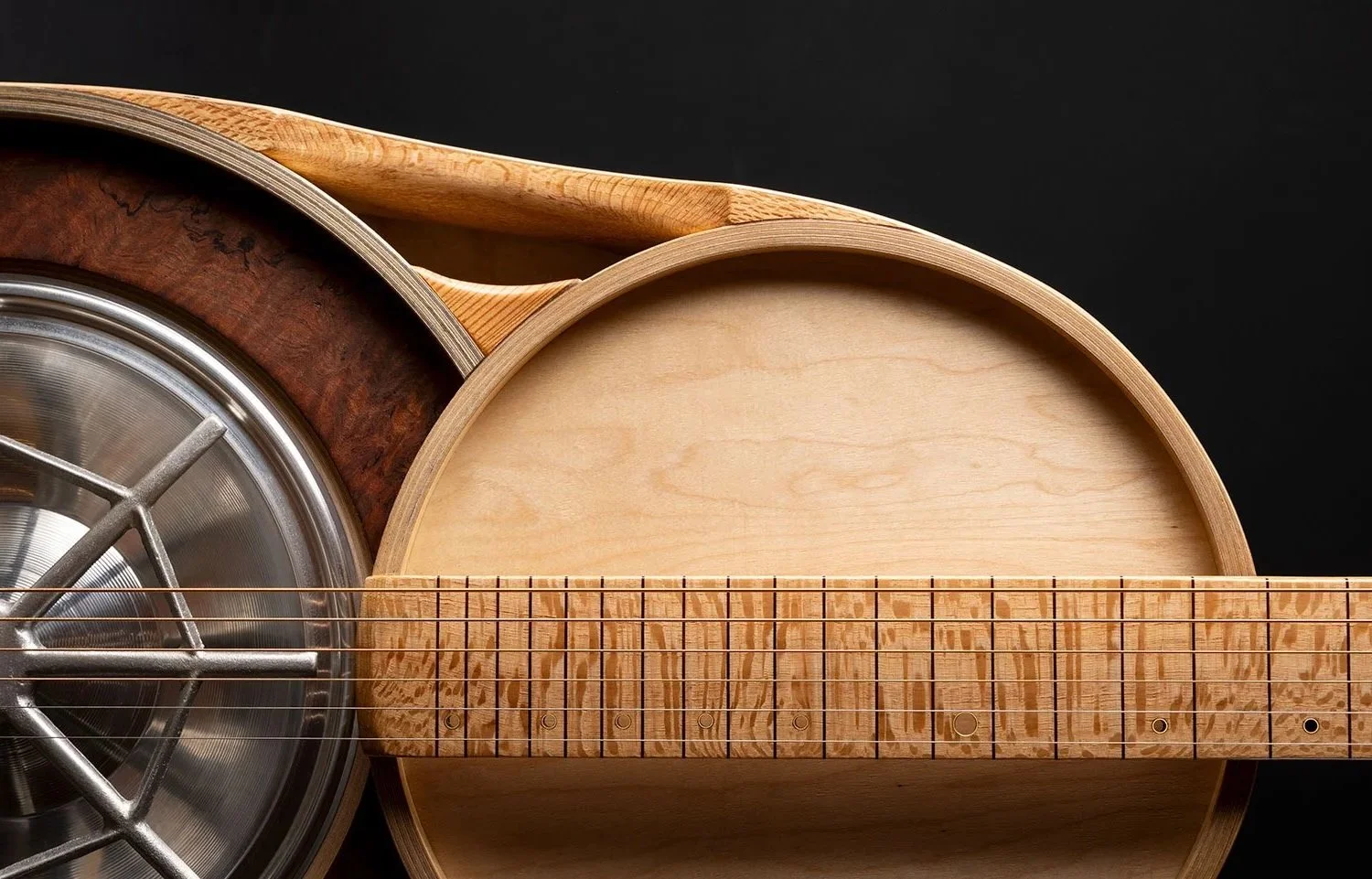
Pragmatism is the key to my ethos toward design. With little that is gratuitous, I have exposed as much of the structure as possible, as I see beauty in simplistic functionality. The leg rest along the neck doubles as a handle whilst also adding mass to the headstock, the sound holes serve as lateral structure of the chassis and a comfortable way to hold the guitar.
In simplistic terms, what I came to was a separation of the primary duties of the components of the instrument. Whereas a traditional guitar requires the top and the back to have structural integrity, my design has a structure that deals with all of the forces applied to the instrument and non-structural soundboards.