

An alternative strategy for Lap Steel & Resonator guitar design
I did try to follow the guitar-making recipe, but, to be honest, it felt too prescriptive to me. My interest was in lap steel and resonator guitars, and they all seemed to be modified versions of a traditional guitar. Every decision had been refined to be centred on a regular fretted playing style. The waist shape to rest on the leg, the body being constrained to allow access to the upper frets, and the dimensions of the neck to be able to fret the instrument.
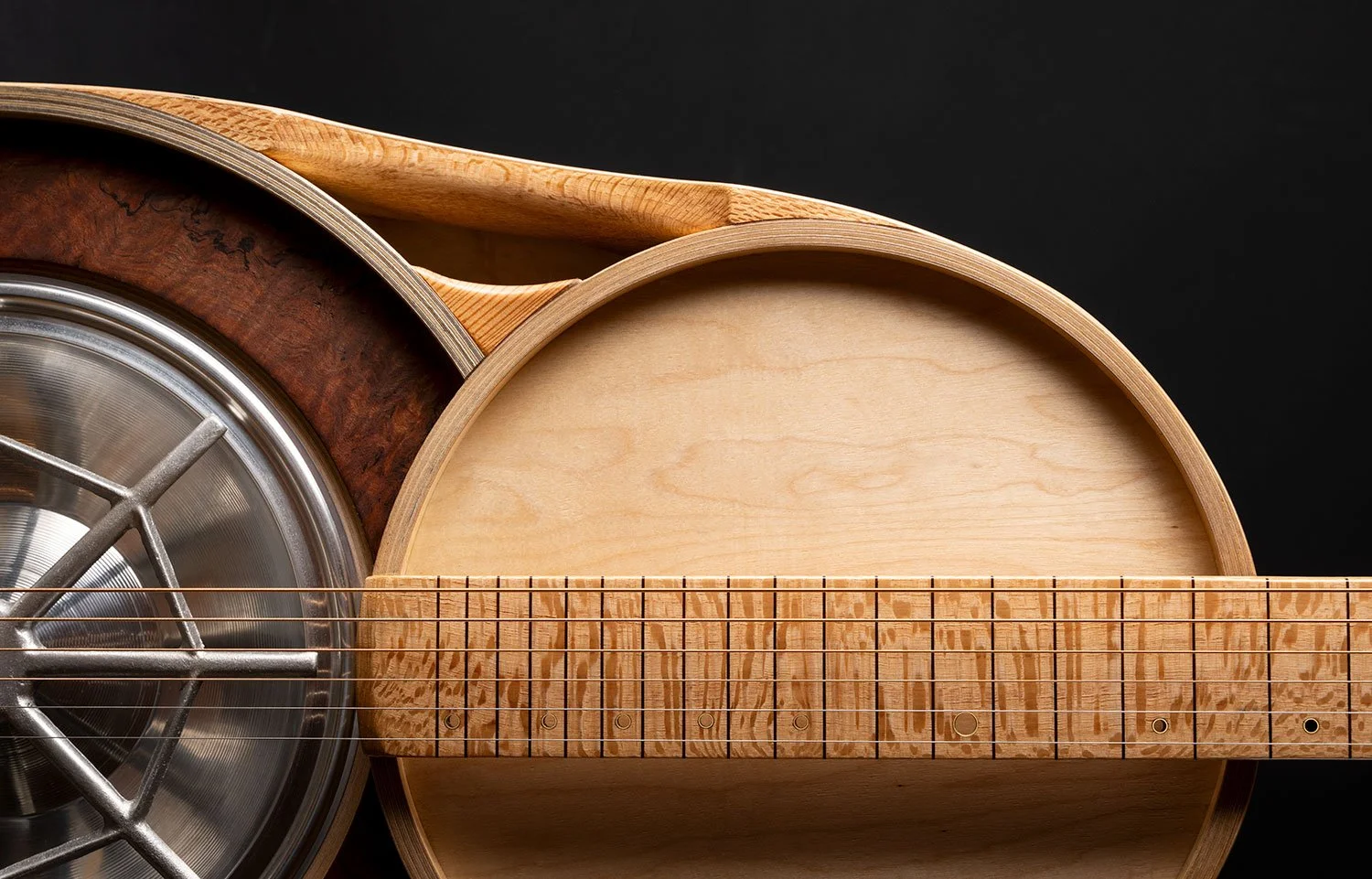
My mission gradually developed into creating a lap steel instrument that was specifically conceived for lap players. This opened the way for a ground-up rethink and offered a raft of different design options that I could pursue.
For those of you who may not be familiar with lap steels, they fundamentally differ from a regular acoustic guitar in a number of ways. Lap steels are laid flat on your lap with the strings facing up, the action/height of the strings is up to 10mm off the fretboard, and they are played with a steel/slide rather than using the fret to shorten the vibration of the string.
By starting with a clean-sheet design, I had the freedom to reconsider everything. I focused on the imperatives, which were to make an instrument that sounded beautiful, had good projection, and was comfortable for lap slide playing and handling. I was also open to seeing if there was more to be had, especially from resonator guitars. Tri-cone resonators and spider-bridge resonators, Dobro’s, have been my focus.
My ethos was: no idea is safe, no idea is off the table. Having a firm set of opinions is the enemy of progress. I came into this practice without the dogma of right and wrong of guitar building. Every single aspect of my guitar builds has earned inclusion through actual experimentation. If it didn’t improve the instrument, it wasn’t included.
The high action of a lap steel leaves the strings independent of the fretboard, allowing me incredible freedom in prototyping with my dismantlable prototype bodies. Each prototype was made of a core structure of the neck and sides. With this chassis as a constant, I could experiment with every variable. I could A-B test just about anything…and I did! Depending on the prototype, I could swap out radically different top and back designs, tailpieces, scale length, nut and bridge design and materials.
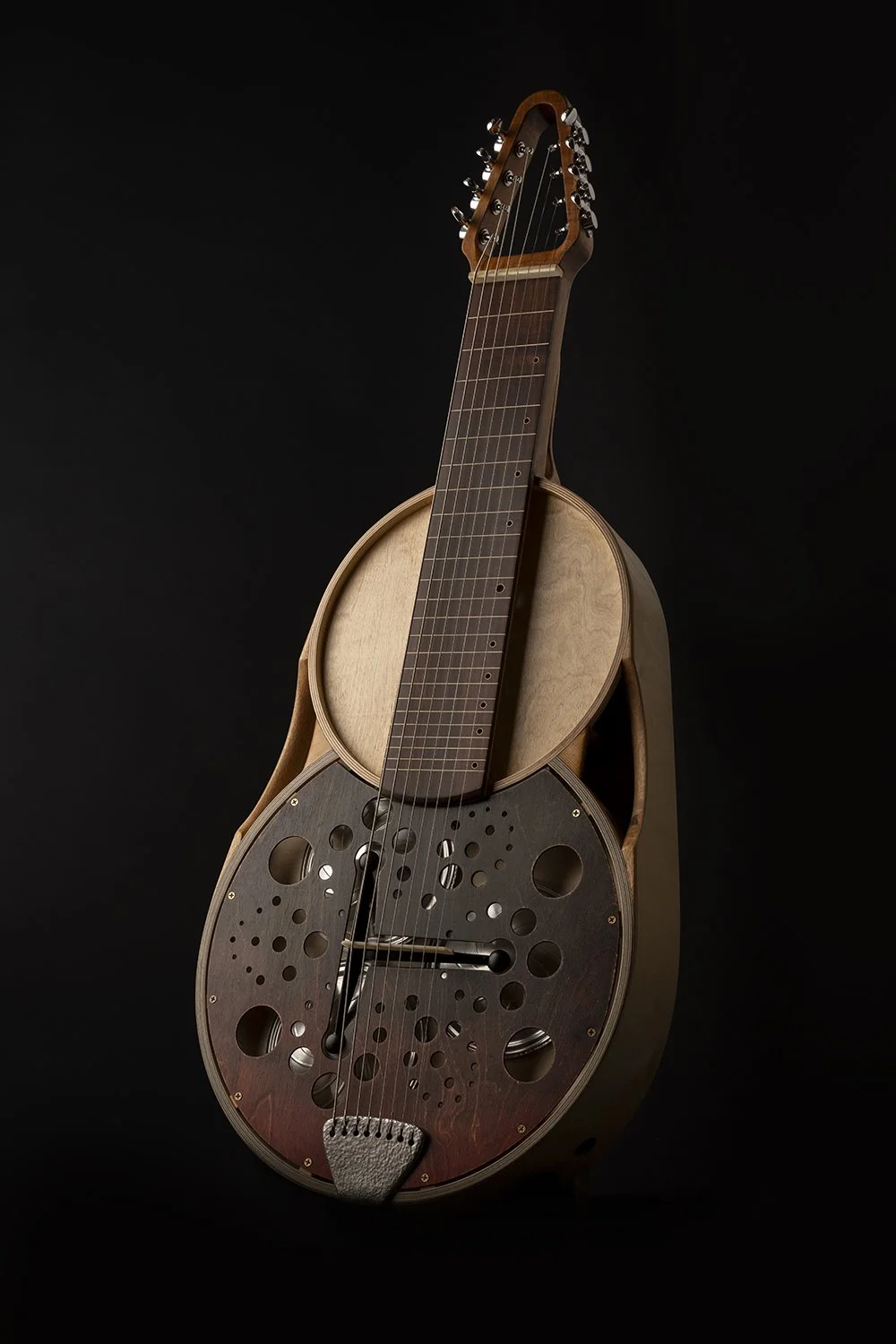
I have ended up with a fundamentally different design premise. The soundboards are free-floating areas that are surrounded by structure. The structure manages all the forces applied to the instrument by string tension and reflects the energy played into the instrument back into the soundboards. The soundboards are recessed into the chassis, so they are not muted by resting the player's legs. The sound holes have been repositioned to either side of the waist.
A big part of my journey has been to try to establish how the physical environment within the instrument plays into the propagation of tone. I experimented with the shape of the sound chamber and passive amplification in the form of horn-shaped sound hole outlets.
Having had such a great sonic response from using aircraft-grade plywood for my hand percussion instruments, it seemed like an obvious choice for soundboard materials. I use aircraft-grade birch ply for my soundboards and solid timber for the necks, with a mix of both for chassis components. I have had to overcome a very specific set of issues to make this peculiar style of instrument design work. The birch ply is an immensely flexible material to work with; it’s very consistent, and it’s sustainably sourced. It’s definitely the right material for my application. The ear test is the arbiter of my decisions around material choice. Does it sound good, or not?
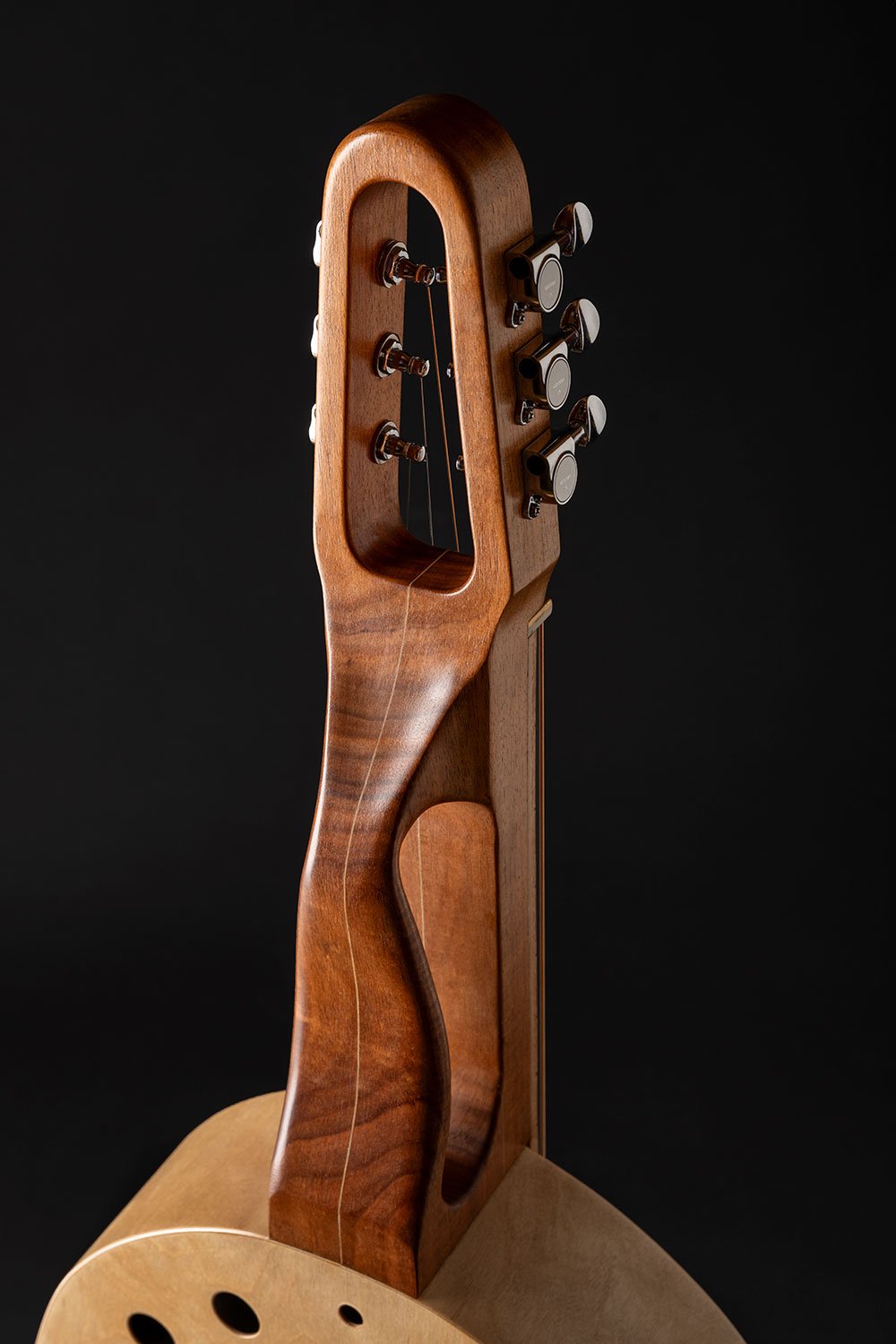
One design theme I am particularly proud of is my handle design. It runs along the back of the neck and resolves several key ‘lap steel’ issues. Handling a square-neck guitar isn’t much chop; the necks are fat, and you inevitably end up squeezing the strings down onto the fretboard. I was able to make a very comfortable handle that eliminates touching the strings. It is sculpted to be a leg rest that integrates with the body and raises the neck position, levelling out the playing position. It also adds mass to the neck, which improves tone. And apart from anything else, I think it looks beautiful.
I wasn’t aiming to make a sonic or visual replica of traditional instruments. Nor was I trying to make a novelty instrument; I was in search of an alternative means to fulfil the objectives of a lap steel guitar and see if I could find improvements in ergonomics, tonality, projection and sustain. I am pleased to say that these instruments are loud, have their own voice, and are a joy to hold and play. A byproduct of all of this is that they look unique, too.