

Surely there is another way? An alternative journey into musical instrument design.
I had a real problem with the imposed rule; this is the only way to make a … instrument! Surely there are other structures that could facilitate all of the requirements of a traditional instrument, but through employing an alternative strategy. I was fascinated by the idea that maybe, if I put in enough energy, I might even find something new?
I feel that I’m in a unique position to approach musical instrument design. I have been collecting and attempting to play a very broad range of instruments since my teens. I don’t have any training in woodwork or traditional instrument-making, nor a preoccupation with specific strategies for building them. I’m not even a trained musician. But I have spent thousands of hours making music, in addition to the thousands of hours I’ve spent enraptured with other people's music. I’m not attached to accurately replicating what already exists. My interest is in seeing if there are other viable options that might offer difference, not for novelty, but for the sake of progression. My designs are aimed at providing all of the functional and aural joy expected of a traditional instrument, but in a re-packaged form that might have other inherent advantages.
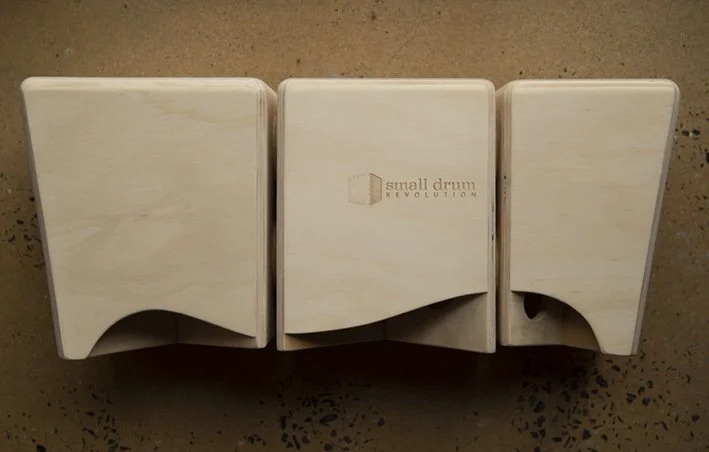
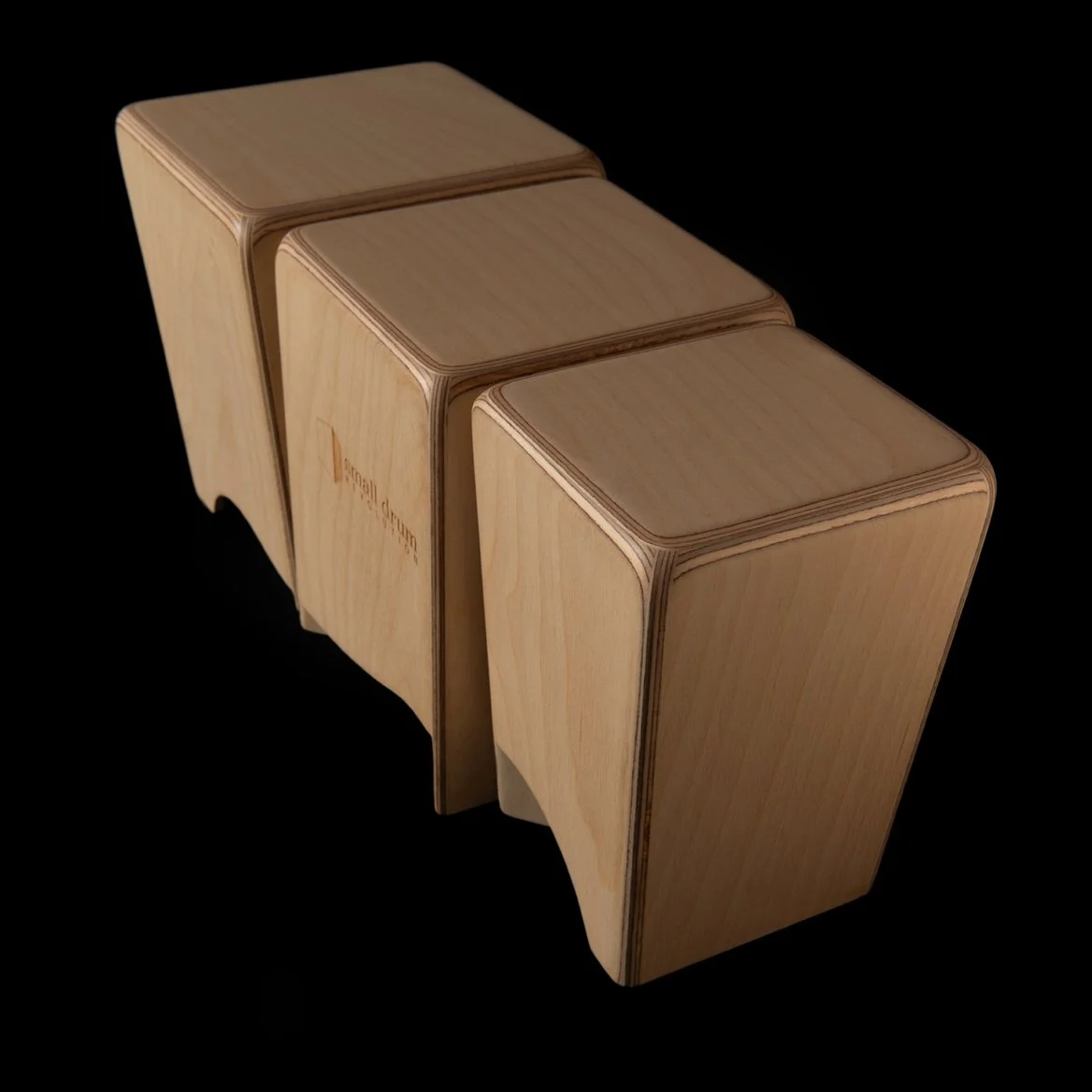
My triple bongo design is a great demonstration of this ethos. The benefits of this design were possible by using a modern material, aircraft-grade plywood. On a practical level, I halved the weight of a traditional instrument, and I removed all of the sharp edges, all in an instrument that doesn’t need to be tuned. The weight reduction and comfort levels of soft touch points have vastly improved the playing experience. But the real progression came from the packaging, which allowed for the addition of a third drum within the same footprint. The instrument can still fulfil its role in an ensemble, but three notes open the way for melodic soloing. There is no compromise as these are three individual structures. Each drum has three distinct notes across the playing face and clean harmonics, much like a trad instrument. The projection and tone are excellent. They are not trying to be a perfect replica of a skinned drum, but they sit in the same frequency range in the mix, fulfilling the same requirements of note length, timbre and tonality. Different to a degree but definitely not alien.
The multi-faced cajon is another example of difference for a reason. Conventional thinking is that a cajon is a structural box with an open front with a playing face screwed to it. The restriction imposed on the thinking around the design is that the structure has to be the sides of the instrument, but what if the structure could be placed within the instrument? The other issue which I considered retrospectively was deflection. When the player puts their weight on the front of the instrument, the tension in the front face is slightly reduced, affecting the tone.
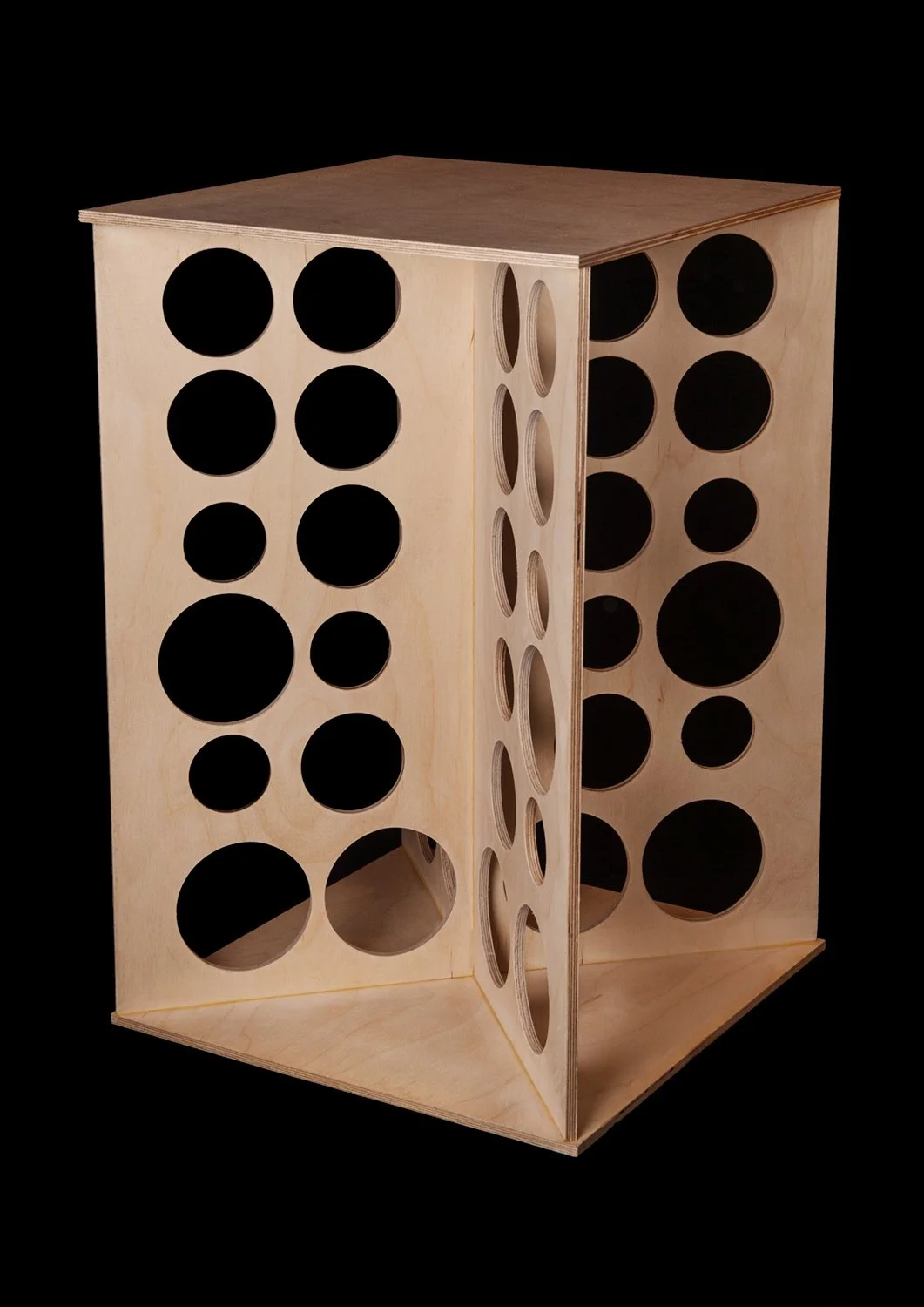
The placement of an X chassis structure, from top to bottom, and corner to corner, had a number of benefits. The overall rigidity of the instrument went through the roof, with energy retention increasing in the playing face. The tonality of the front face developed in harmonic complexity and volume, as well as offering stunningly rich tone and a wider variety of distinct notes across the face. And now, any of the four sides were able to be uncompromised drum faces that could each be a set pitch. This became a multi-faced tuned percussion instrument, all within the same footprint and weight as a single-faced cajon. The timbre of these faces is spectacularly musical, and way beyond what I have heard in other cajons, and all within a compact, lightweight instrument.
The use of a taut structure is not new, but usually requires considerable mass and moving parts; think of traditional bongos. Using aircraft-grade plywood has offered me a chance to undo the imposed thinking of all of my instrument designs. By using aircraft-grade plywood, I have a range of new design options for ergonomics, packaging and tonality. I am able to create adaptive instruments to suit specific players' physical requirements, as well as vastly extending the range of traditional concepts for instruments.