

A journey into the centre of the cajon
The most profound understandings of my instrument-making were based on the most viable materials and the relevance of structure and mass.
For the first cajon I made, I managed to source a piece of aircraft-grade ply that a local cabinet maker had had in the back of his workshop for 15 years. The tap-tone of this wood was bright and melodious; it was a gift.
Having had a lot of exposure to instrument makers, I understood the rationale of quality tone woods in instruments. I didn’t know that ply this good was even available, so stumbling across such a great piece of material propelled me forward. There is no doubt in my mind now that aircraft-grade plywood is the optimum material for hand percussion and, by extension, my guitar soundboards and structural components.
I made an instrument to the same specifications as a cheap cajon I had borrowed, and it sounded like an entirely different instrument. To be more precise, it sounded like an instrument. It had a depth, richness and punch that was absent in the cheap cajon.
The next fundamental aspect I needed to develop was my understanding of how structure influences energy propagation. My process rarely involves following the recipe. If I think I have a viable idea, I’d make iterations of instruments and assess their performance. I immediately started playing with the idea of drums with different-pitched front and back faces. Then I stepped off down the rabbit hole.
I built a small, cube-esque cajon with 6 playing faces. At only 30cm tall, this drum was an ergonomic nightmare for someone of my height. Then there was the disordered layout of the differently pitched faces to contend with. It was a stunning example of what not to do, but it was the proof of concept of a chassis and the viability to tune faces. The quality of the sound of some of the faces of that drum was astounding, and the potential of the versatility that a chassis could offer was obvious.
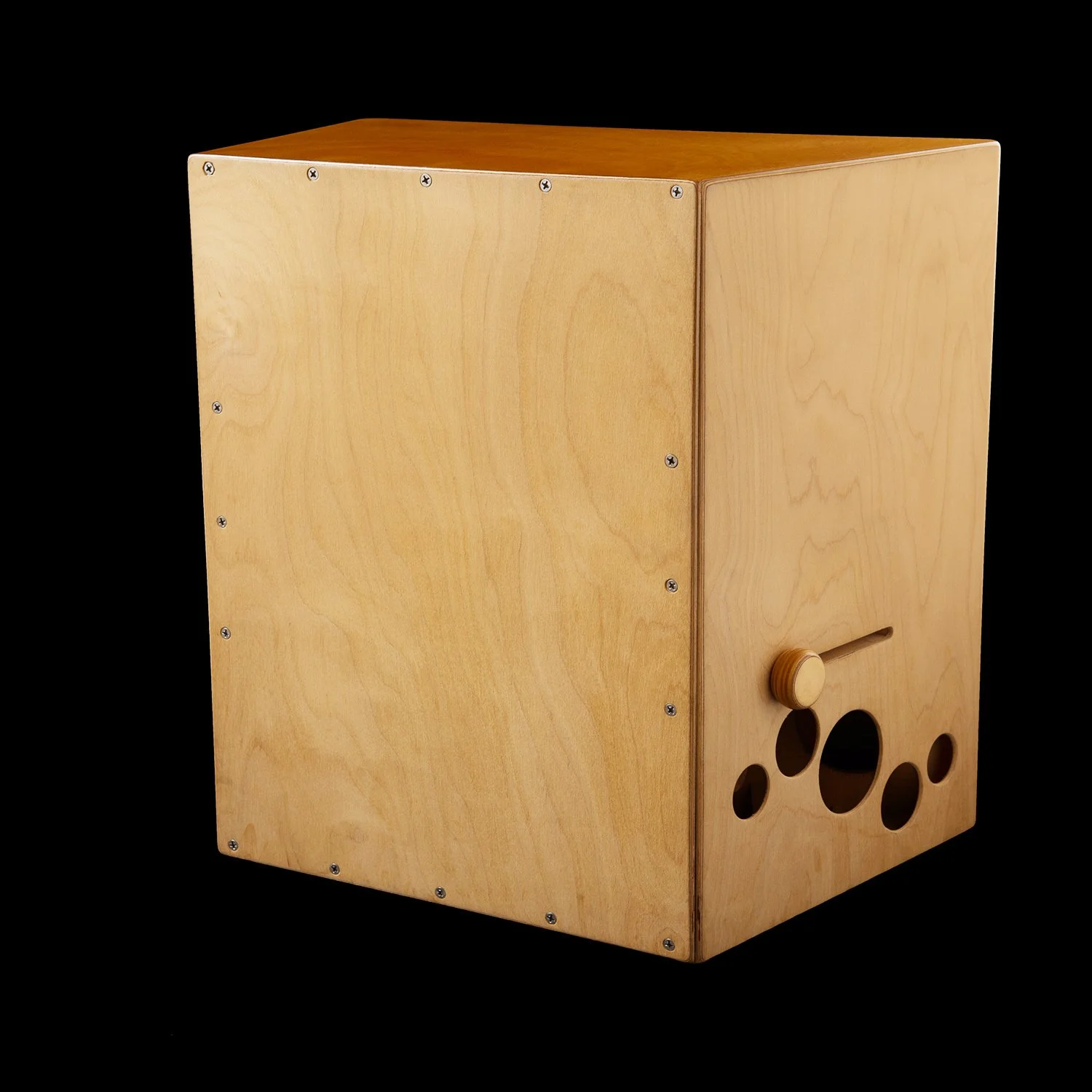
Nine faced cajon hybrid
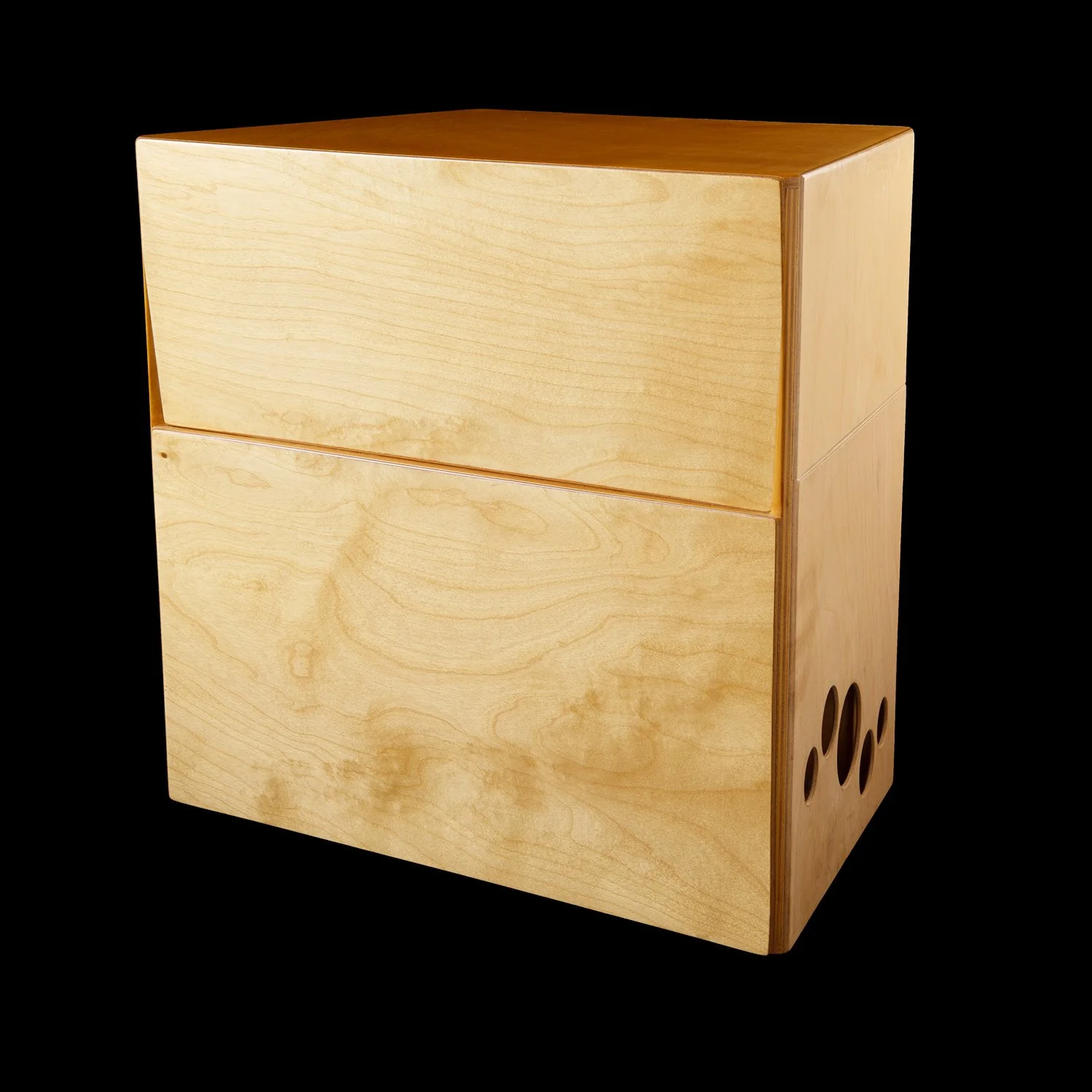
Nest of bongos across the back of nine faced cajon hybrid
Then I got really ambitious. I started work on the most complicated cajon drum I’ve ever made, a nine-faced cajon with the faces tuned to each other. A screwed front face, a conga face on the left-hand side, a bongo on the right, and the wider wedged sides facilitate a back that houses a triple bongo across the top, and a pair of oversized bongos across the bottom. Because of the X chassis, every playing face is supported by an incredible structure, so no face is compromised. The front face even has an infinitely adjustable snare. This instrument is very special, and also incredibly complicated to make.
The next iteration was a more viable instrument to offer for sale. They were a less refined version of the cajons I’m make now, a square foot print with rectangular sides, with either four or five tuned playing faces.
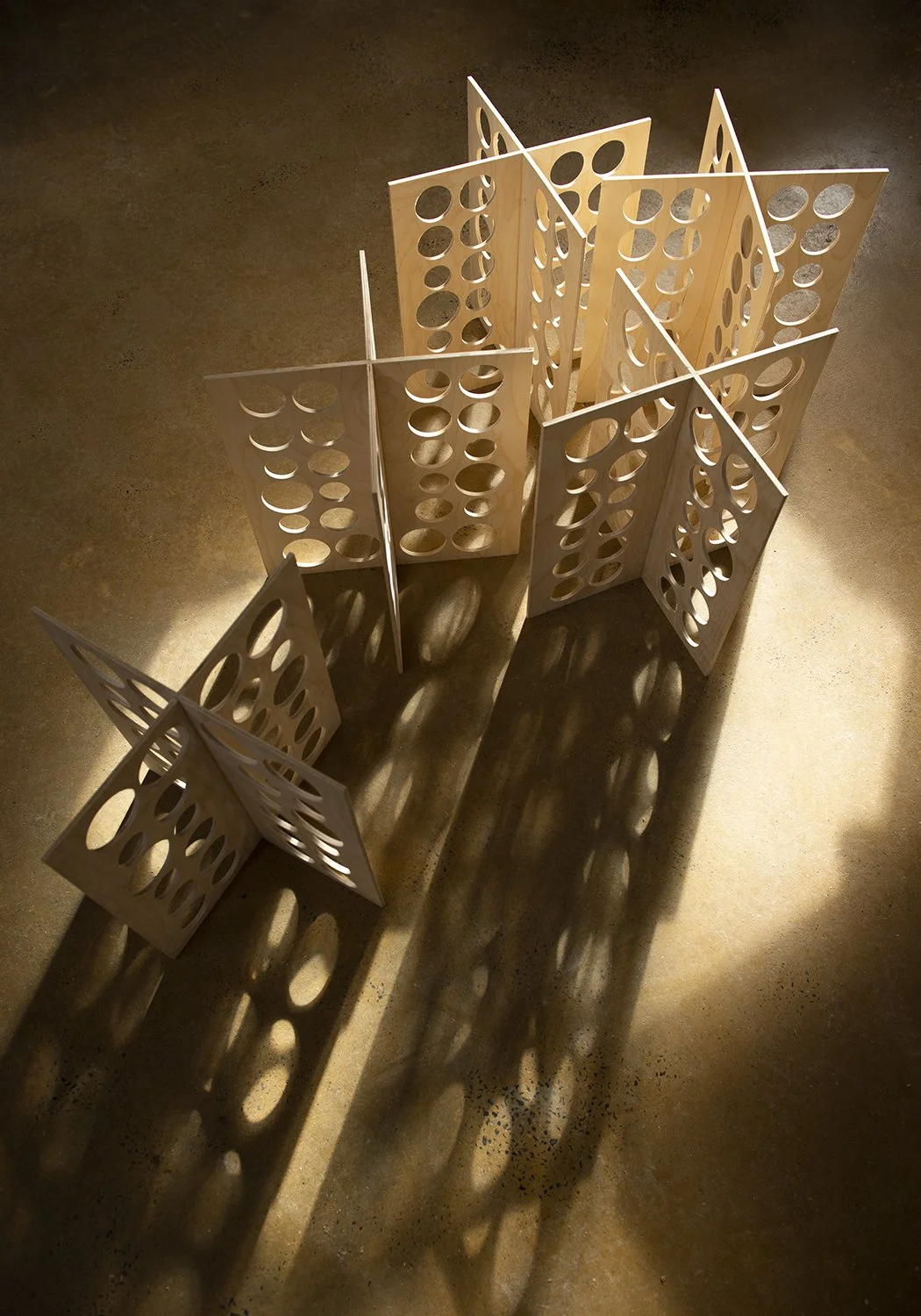
Chassis
The X chassis proved the point that structure was as important to tone as material in the propagation of tone, sustain and volume. Think of conga and bongo drums; they have solid wood shells and steel hardware. They are also built using circles, an inherently strong shape. I’m trying to reproduce the structural integrity of hardwood shells in my cajons without the sheer mass and uncomfortable hardware. Lightweight materials that are engineered into very sturdy structures can enact the same responses of energy output.
I’m trying to convert the maximum amount of energy from the players' hands to sound energy. The placement of mass is very important. I am removing mass from the centre of the chassis and adding it to the edges. The more structure I can create at the points where the playing face meets the chassis, the greater the retention of energy in the face. The maximising of energy through the vibrating areas is everything in an instrument. It’s relative to the instrument; a banjo releases its energy very quickly and loudly, and a piano releases its energy much more slowly. Theoretically, an efficient instrument will have inherently greater dynamics, better tone and better sustain.
Because of the chassis at the centre of this design, I can build an instrument with a massively increased range of uses without any real drawbacks. The cajon design I have settled with has five tuned professional-quality sounding drums in a body that is the same foot print and weight as a regular instrument. There are huge benefits to being able to roll up to a gig or recording session with one instrument that does many things very well.